King Harold II
1022 – 1066 · Generation VI · King of the English (Jan–Oct 1066)
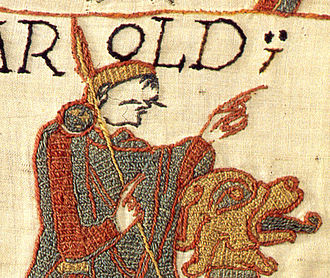
Harold Godwinson, the last crowned Anglo-Saxon king of England, was born in the early 1020s, probably around 1022, into one of the most powerful families in the kingdom. His father, Godwin, had been made Earl of Wessex by Cnut the Great. His mother, Gytha, was the sister of Earl Ulf, who had married Cnut’s own sister. In 1045 Harold’s sister Edith married King Edward the Confessor, and at about the same time Harold became Earl of East Anglia. Around then he also began a long union with Edith the Fair, a marriage in the Danish manner that the Church did not bless but lay society accepted, and they had at least five children.
The family’s power alarmed the king. In 1051 Edward drove the Godwins into exile, and a year later they came back with an armed force and compelled him to restore them. When Godwin died in 1053 Harold succeeded him as Earl of Wessex, the greatest layman in England after Edward himself. He refounded the church at Waltham in Essex, and his campaigns of 1062 and 1063 broke the Welsh king Gruffudd ap Llywelyn. In 1064 or 1065 came the strangest episode of his career. He crossed the Channel, for reasons the sources dispute, was driven ashore in Ponthieu and taken prisoner, and was handed over to Duke William of Normandy. He fought beside William in Brittany. Norman writers and the Bayeux Tapestry say that before going home he swore on holy relics to support the duke’s claim to the English throne. English records from before 1066 say nothing about the episode.
In 1065 the Northumbrians rose against their earl, Harold’s brother Tostig. Harold accepted Tostig’s removal, and his brother went abroad an enemy. Edward died childless on 5 January 1066. According to a life of the king written soon afterwards, he had on his deathbed commended his widow and the kingdom to Harold’s protection. The council of magnates chose Harold the next day and he was crowned at once, probably in Westminster Abbey, which would make him the first king crowned there. He went north to York to secure the loyalty of Northumbria, and he had by now married Ealdgyth, sister of the northern earls Edwin and Morcar.
Two rivals prepared to invade. William built a fleet in Normandy and won the Pope’s backing by pointing to the broken oath. Harold kept an army and ships on the south coast all summer, until provisions ran out on 8 September and he had to send the men home. At that moment King Harald Hardrada of Norway landed in the north with Tostig at his side. They beat Edwin and Morcar at Fulford, near York, on 20 September. Harold marched north at speed, surprised the invaders at Stamford Bridge on 25 September, and destroyed them. Hardrada and Tostig were both killed, and of some three hundred ships the survivors are said to have needed only twenty-five to sail home.
Three days later William landed at Pevensey in Sussex. Harold hurried south, gathered what forces he could in London, and took up a position on a ridge a few miles from Hastings. The battle on 14 October lasted most of the day. The English fought on foot behind a wall of shields and held the ridge for hours, until the line was broken at last and Harold was killed along with his brothers Gyrth and Leofwine. How he died cannot now be established. The tradition that an arrow struck him in the eye rests on the Bayeux Tapestry, where the arrow may owe something to later restoration, and on twelfth-century writers, while an early Norman poem on the battle has him cut down by four knights. William of Poitiers says that the Conqueror refused Gytha’s offer of her son’s weight in gold for the body and gave it to one of his own followers to bury. Later tradition held that Harold was reburied at Waltham, and others have suggested Bosham, but where he lies is not known. William founded Battle Abbey on the field, with its high altar on the spot where the king was said to have fallen.
Images
- Harold swears an oath on relics before Duke William, Bayeux Tapestry, 1070s (Bayeux Tapestry (photo Myrabella), public domain)
- Coin of Harold II, 1066 (PHGCOM, public domain)
- “Here King Harold is slain”: the death scene in the Bayeux Tapestry, 1070s (Bayeux Tapestry (photo Myrabella), public domain)
- The stone at Battle Abbey marking the high altar, traditionally the spot where Harold died (Néstor Daza, public domain)


Parents
- Godwin Earl of Wessex (1001 – 1053)
- Gytha Thorkelsdóttir (1000 – 1069)
Siblings
- Edith of Wessex (1025 – 1075)
Life
- 1022 — Born
- 1066 — Died
- 1066 — Harold Godwinson becomes King Harold II
- 1066 — Harold II fights his brother Tostig and a Viking force under Harold Hadrada and defeats them at Stamford Bridge. He hastily marches South at the news that William Duke of Normandy with 100 ships has landed at Pevensey Bay and marched into Sussex.
- 1066 — Harold II is killed at the Battle of Hastings according to legend with an arrow through his eye.
Sources
- Harold Godwinson · Wikipedia
- Harold II (r. Jan – Oct 1066) · The Royal Family (royal.uk)
- A Restless Reign: Harold II in 1066 · English Heritage
- Harold Godwinson · World History Encyclopedia