King John
1166 – 1216 · Generation XII · King of England (r. 1199–1216) · House of Plantagenet
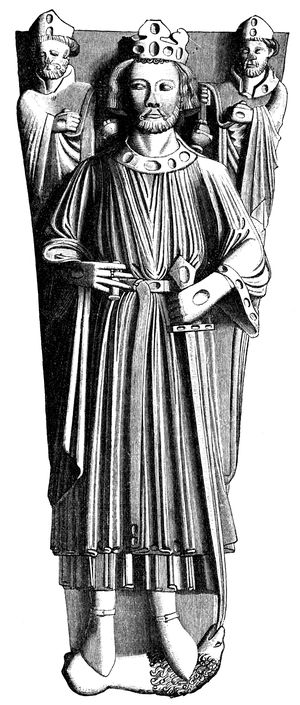
John was the youngest son of Henry II and Eleanor of Aquitaine, born around Christmas in 1166 or 1167. Historians still debate the year, and some accounts place the birth at Oxford. As the youngest of the family he seemed unlikely to inherit much, and his father jokingly called him “Lackland”, a name that stuck. He spent his earliest years at Fontevraud Abbey and was later taught by the royal administrator Ranulf de Glanvill. After his brothers rebelled in 1173 he became Henry’s favourite. In 1177, at ten, he was made Lord of Ireland, but his first visit there in 1185 was a failure, remembered for his mockery of the Irish kings’ long beards.
Richard I made him Count of Mortain, gave him wide English lands, and married him to the heiress Isabella of Gloucester in 1189. None of this bought his loyalty. While Richard was on crusade, John set himself up as a rival to the king’s chancellor, William Longchamp, and when Richard was held captive in Germany he allied with Philip II of France and raised forces in England. The plot collapsed on Richard’s return in 1194. Richard forgave him, and for the rest of the reign John served his brother on the continent, to all appearances loyally.
When Richard died in April 1199, John claimed the throne against his nephew Arthur of Brittany and was crowned at Westminster Abbey in May with his mother’s support. In 1200 his first marriage was annulled and he married Isabella of Angoulême, who was already promised to Hugh de Lusignan. Hugh appealed to Philip II as John’s overlord, and when John refused to answer Philip’s summons the French king declared his lands forfeit. John captured Arthur at Mirebeau in 1202, but Arthur then vanished in his custody, and modern historians believe John had him killed. Normandy fell to Philip in 1204.
The next decade was given to winning it back. John spent far longer in England than his predecessors had, took an active part in government and justice, and raised money with a thoroughness that made him hated. He built up a navy, reformed military service and gathered allies against France. A dispute with Pope Innocent III over the election of an Archbishop of Canterbury, which John lost when Innocent consecrated Stephen Langton in 1207, led to an interdict on English church services from 1208 and to John’s excommunication in 1209. In 1213 he submitted, making England a papal fief, and from then on he had the Pope’s backing. His great campaign of 1214 ended when his allies were beaten by Philip at Bouvines.
Back in England, John faced rebellion. The barons, many of them his debtors in the north, renounced their allegiance in May 1215 and seized London. On 15 June 1215 John met them at Runnymede, near Windsor, and agreed the charter later called Magna Carta, which promised protection from unlawful imprisonment, swift justice and no new taxes without baronial consent, and set up a council of twenty-five barons to hold the king to it. Neither side kept it. Innocent annulled the charter at John’s request, and civil war followed. The rebels invited Prince Louis of France to take the crown, and he landed in Kent in May 1216. That autumn John caught dysentery at Lynn, reportedly lost part of his baggage crossing the tidal inlets of the Wash, and died at Newark Castle on the night of 18–19 October 1216. He was buried in Worcester Cathedral before the altar of St Wulfstan.
With Isabella of Angoulême he had five children, among them his heir Henry III, who was nine when his father died, and Richard of Cornwall, later King of the Romans. Chroniclers writing soon after his death, Roger of Wendover and Matthew Paris above all, fixed his reputation as a villain, and he remains the bad king of the Robin Hood stories. Historians working from the records of his government have since credited him with real ability as an administrator, and his judicial reforms shaped the later common law. Magna Carta, reissued after his death, outlived him to become a founding text of English constitutional history.
Place in the family
- King John was a 8× great-grandfather of King Henry VIII.
- King John was the younger of 2 children of King Henry II and Eleanor of Aquitaine recorded in this archive.
- The archive records 141 of his descendants, across 28 generations.
Images
- One of the four surviving 1215 exemplars of Magna Carta, now in the British Library (Unknown scribe, public domain)
- King John hunting a stag with hounds, from a 14th-century manuscript of the Statutes of England (Unknown illuminator; British Library, CC0)
- John and his five children by Isabella of Angoulême, from a 13th-century genealogical manuscript (Unknown artist, public domain)
- A silver penny struck in John’s reign, around 1209 (Rasiel Suarez, CC BY-SA 3.0)


One of 26 people of House of Plantagenet (1126–1485) in this archive. The longest-reigning English house, counting its Angevin beginning and the rival Lancaster and York branches that fought the Wars of the Roses.
Line of descent: King William I The Conqueror → King Henry I → Matilda the Empress → King Henry II → King John.
Parents
- King Henry II (1133 – 1189)
- Eleanor of Aquitaine (1122 – 1204)
Siblings
- King Richard I The Lion Heart (1157 – 1199)
Partners
- Married Isabella of Angoulême (1188 – 1246) in 1200 — one child together
Children
- King Henry III (1207 – 1272)
Life
- 1166 — Born
- 1199 — John accedes to the throne on the death of his brother, Richard I.
- 1200 — Married Isabella of Angoulême
- 1205 — John refuses to accept Stephen Langton as Archbishop of Canterbury
- 1209 — Pope Innocent III excommunicates John for his confiscation of ecclesiastical property
- 1212 — Innocent III declares that John is no longer the rightful King
- 1213 — John submits to the Pope’s demands and accepts the authority of the Pope
- 1215 — John meets the English barons at Runnymede, agrees to their demands, and seals the Magna Carta which set limits on the powers of the monarch, lays out the feudal obligations of the barons, confirms the liberties of the Church, and grants rights to all freemen of the realm and their heirs for ever. It is the first written constitution.
- 1215 — The Pope decrees that John need not adhere to the Magna Carta, and civil war breaks out
- 1216 — Died
- 1216 — The barons seek French aid in their fight against John. Prince Louis of France lands in England and captures the Tower of London
- 1216 — John flees North and loses his war chest of cash and jewels in the Wash estuary
- 1216 — John dies of a fever at Newark and is buried Worcester Cathedral
Sources
- John, King of England · Wikipedia
- John Lackland (r. 1199–1216) · The Royal Family (royal.uk)
- King John of England · World History Encyclopedia