King Cnut (Canute)
990 – 1035 · Generation V · King of England, Denmark and Norway (r. 1016–1035)
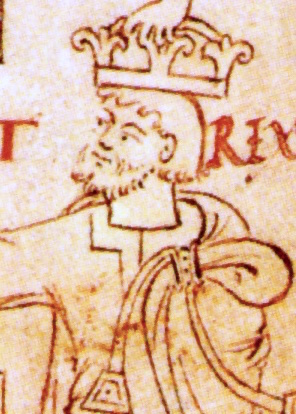
Cnut, or Canute (died 1035), was a Danish prince who conquered England in 1016 and went on to rule Denmark and Norway as well, a grouping of kingdoms that historians call the North Sea Empire. He was a son of Swein Forkbeard, king of Denmark. Neither the date nor the place of his birth is recorded, and estimates run from about 990 to about 1000. His mother’s identity is disputed, though she may have been a Polish princess.
He first appears for certain in 1013, when he crossed to England with his father’s invading army. By the end of that year Swein was acknowledged as king and Æthelred the Unready had fled to Normandy. Swein died only weeks later, in February 1014. The army chose Cnut to succeed him, but the English recalled Æthelred, who drove the young man back to Denmark. In the summer of 1015 Cnut returned with a fleet said to number two hundred ships. Fourteen months of hard fighting against Æthelred’s son Edmund Ironside ended on 18 October 1016 at Assandun in Essex, where the English were decisively beaten. The two kings divided the country at the Thames. Edmund died on 30 November, and Cnut took the whole.
He began ruthlessly. Members of the old royal house were killed or driven abroad, and several English nobles were executed, the treacherous Eadric Streona among them. In July 1017 he married Emma of Normandy, Æthelred’s widow, although he already had a consort in Ælfgifu of Northampton, the mother of his sons Swein and Harold. The Church did not count Ælfgifu as his wife. Whether he put her aside is disputed, and he certainly kept up the connection, later sending her to govern Norway. In 1018 he raised a tax of £82,500 to pay off his fleet, and sent most of it home. After that he governed much as an English king would. He confirmed the laws of King Edgar, issued codes drafted largely by Archbishop Wulfstan of York, gave generously to churches his countrymen had once plundered, and came to rely on English earls such as Godwin of Wessex. For nearly two decades England suffered no serious attack from abroad.
He inherited Denmark when his brother Harald died in 1018. Around 1026 he fought the kings of Norway and Sweden at the Holy River, a battle whose outcome the sources dispute but which left him the strongest ruler in Scandinavia. At Easter 1027 he was in Rome for the coronation of the emperor Conrad II. There he persuaded the pope to reduce the fees his archbishops paid for the pallium and won his subjects freedom from tolls on the road to Rome, and he wrote home styling himself king “of all England and Denmark and the Norwegians and of some of the Swedes”. In 1028 he sailed to Norway with fifty ships, drove out Olaf Haraldsson and was accepted as king at Trondheim. Scottish kings submitted to him as well, in 1027 or 1031, though his influence there was slight. Norway, entrusted to Ælfgifu and their son Swein, was harshly governed and had slipped away by the time he died.
Cnut died at Shaftesbury in Dorset on 12 November 1035 and was buried in the Old Minster at Winchester. His bones are believed to rest in the painted mortuary chests of Winchester Cathedral, mixed with those of other kings and bishops since Parliamentarian soldiers scattered them in 1642. His empire did not outlive his sons. Harold Harefoot died in 1040 and Harthacnut, his son by Emma, in 1042, after which England returned to the old dynasty under Edward the Confessor.
He is best remembered for a story first told by Henry of Huntingdon a century later. Seated on the shore, the king commands the tide to halt, gets his feet wet, and tells his courtiers that a king’s power is nothing beside God’s. It was meant to show his piety. Retelling has turned it into a tale of vanity, which would have puzzled the chroniclers who admired him, and the historian Norman Cantor, who called him “the most effective king in Anglo-Saxon history”.
Images
- Edmund Ironside and Cnut in combat at Assandun, from Matthew Paris’s thirteenth-century Chronica Majora. (Matthew Paris (Corpus Christi College, Cambridge, MS 26), public domain)
- Silver penny of Cnut of the quatrefoil type, struck at York about 1017–1023. (York Museums Trust (Emily Tilley), CC BY 2.0)
- Runestone U 194 at Väsby in Sweden, raised by a man who records taking Cnut’s payment in England. (Berig, CC BY 2.5)
- Cnut rebuking his courtiers on the seashore, an illustration of the legend published in 1848. (R. E. Pine, public domain)


Partners
- Married Emma of Normandy (985 – 1052) in 1017 — one child together
Children
- King Harthacnut (1018 – 1042)
Life
- 990 — Born
- 1017 — Married Emma of Normandy
- 1017 — Canute marries Emma of Normandy, the widow of Aethelred II. Canute divides England into four earldoms - Northumbria Wessex, Mercia and East Anglia.
- 1027 — Canute makes a pilgrimage to Rome to demonstrate his alliance with the Church, and attends the coronation of the Pope
- 1028 — In addition to his existing kingdoms Canute becomes King of Norway
- 1035 — Died
- 1035 — Canute dies at the age of 40, and his huge Northern European empire disintegrates.
Sources
- Cnut · Wikipedia
- Canute ‘The Great’ (r. 1016–1035) · The Royal Family (royal.uk)
- Cnut the Great · World History Encyclopedia
- Mortuary Chests: History · Winchester Cathedral