Marie Antoinette
1755 – 1793 · Generation XVII · Queen of France · Habsburg-Lorraine
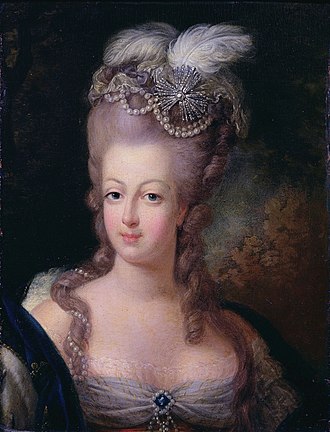
Marie Antoinette, the last queen of France before the Revolution, was born Maria Antonia at the Hofburg in Vienna on 2 November 1755, the youngest daughter of Empress Maria Theresa and the Holy Roman Emperor Francis I. She grew up at Schönbrunn and the family lodge at Laxenburg, learned the harp, harpsichord and flute, and was closest among her many siblings to her sister Maria Carolina, later queen of Naples. Her mother, who ruled the Habsburg lands, treated her children’s marriages as instruments of state, and after the Seven Years’ War France and Austria wanted a wedding to seal their new and unpopular alliance.
The bride chosen was Maria Antonia, the groom Louis-Auguste, grandson and heir of Louis XV. She renounced her claims to Habsburg territory and was married by proxy in Vienna’s Augustinian Church on 19 April 1770, with her brother Ferdinand standing in for the groom. On 14 May she met Louis at the edge of the forest of Compiègne, and two days later, aged fourteen, she married him in person in the royal chapel at Versailles. She took the French form of her name and found the ceremonial of Versailles, where she was watched while she dressed and ate, far heavier than anything she had known in Vienna. Maria Theresa kept up a steady correspondence, pressing her to serve Austrian interests, and the court’s nickname for her, “the Austrian”, stuck for good.
Louis XV died on 10 May 1774 and Marie Antoinette became queen before she was twenty. Within weeks her husband gave her the Petit Trianon, a small château in the park of Versailles, where she could escape court etiquette among friends of her own choosing. She loved balls, theatre and music, played cards and billiards for high stakes, and followed fashion closely. The marriage, however, had still not been consummated seven years after the wedding, a dangerous position for a queen whose security depended on an heir. Her brother, Emperor Joseph II, visited France in 1777 and talked to the couple, and the next year she gave birth to a daughter, Marie-Thérèse, known as Madame Royale. A dauphin, Louis-Joseph, followed in 1781, then Louis-Charles in 1785 and Sophie in 1786, who died in infancy.
Her early popularity did not last. Pamphleteers accused her of extravagance, sexual misconduct and treasonable loyalty to Austria, and many of their stories were plainly invented. By the summer of 1787 she was being called “Madame Déficit”, as though her spending alone had ruined the kingdom’s finances. Her friendship with the Swedish count Axel von Fersen, admitted to her private circle in 1783, fed the gossip. Contemporaries claimed that the two were lovers, and their surviving letters show a strong attachment without settling the question. The Affair of the Diamond Necklace, which came to light in 1785, did lasting harm even though she was its victim: swindlers used a forged signature to obtain the jewel in her name, in a plot in which Cardinal de Rohan was a central figure. The phrase “let them eat cake” is conventionally attributed to her, but there is no evidence that she ever said it.
The Revolution overtook the family in 1789. Her elder son died that June, weeks after the opening of the Estates-General. In October a crowd marched on Versailles and brought the royal family to the Tuileries in Paris, where they lived under guard. Their attempted flight in June 1791 ended with their arrest at Varennes, and it convinced many that the king and queen could not be trusted. When France went to war with Austria in April 1792, she passed military information to Fersen and to the Austrian diplomat Mercy-Argenteau in the hope of rescue. After the Tuileries was stormed on 10 August 1792, the family was imprisoned in the Temple.
Louis XVI was guillotined on 21 January 1793. In July his widow was separated from her surviving son, whom royalists now called Louis XVII, and in the early hours of 1 August she was moved to a cell in the Conciergerie. Her trial before the Revolutionary Tribunal opened on 14 October. Charged with high treason among other things, and faced with an accusation of incest extracted from her son, she was condemned and guillotined on 16 October 1793 on what is now the Place de la Concorde. Her body was thrown into an unmarked grave in the Madeleine cemetery. In January 1815, under the restored Bourbons, her remains and her husband’s were reburied with ceremony in the royal basilica of Saint-Denis.
Place in the family
- Marie Antoinette was a daughter of Maria Theresa.
- Marie Antoinette was the eighth of 9 children of Francis I, Holy Roman Emperor and Maria Theresa recorded in this archive.
Images
- Archduchess Maria Antonia at thirteen, in the portrait sent to Versailles in 1769 ahead of her marriage (Joseph Ducreux, public domain)
- Marie Antoinette with a rose, painted in 1783 (Élisabeth Louise Vigée Le Brun, public domain)
- Marie Antoinette and her Children, painted in 1787 (Palace of Versailles) (Élisabeth Louise Vigée Le Brun, public domain)
- Marie Antoinette on the way to the guillotine, a pen sketch made on 16 October 1793 (Jacques-Louis David, public domain)


One of 24 people of Habsburg-Lorraine (from 1736) in this archive. Maria Theresa’s marriage carried the inheritance into a new name, which its heirs still bear.
Line of descent: Rudolf I of Germany → Albert I of Germany → Albert II, Duke of Austria → Leopold III, Duke of Austria → Ernest, Duke of Austria → Frederick III, Holy Roman Emperor → Maximilian I, Holy Roman Emperor → Philip I of Castile → Ferdinand I, Holy Roman Emperor → Charles II, Archduke of Austria → Ferdinand II, Holy Roman Emperor → Ferdinand III, Holy Roman Emperor → Leopold I, Holy Roman Emperor → Charles VI, Holy Roman Emperor → Maria Theresa → Marie Antoinette.
Parents
- Francis I, Holy Roman Emperor (1708 – 1765)
- Maria Theresa (1717 – 1780)
Siblings
- Joseph II, Holy Roman Emperor (1741 – 1790)
- Maria Christina, Duchess of Teschen (1742 – 1798)
- Archduchess Maria Elisabeth of Austria (1743 – 1808)
- Maria Amalia, Duchess of Parma (1746 – 1804)
- Leopold II, Holy Roman Emperor (1747 – 1792)
- Maria Carolina of Austria (1752 – 1814)
- Ferdinand Karl, Archduke of Austria-Este (1754 – 1806)
- Archduke Maximilian Francis of Austria (1756 – 1801)
Partners
- Married Louis XVI (1754 – 1793) in 1770
Life
- 1755 — Born
- 1770 — Married Louis
- 1793 — Died
Sources
- Marie Antoinette · Wikipedia
- Marie-Antoinette · Château de Versailles
- Marie Antoinette · World History Encyclopedia (Harrison W. Mark, 2022)
- Marie-Antoinette · Encyclopaedia Britannica