King George III
1738 – 1820 · Generation XXXI · King of the United Kingdom (r. 1760–1820) · House of Hanover
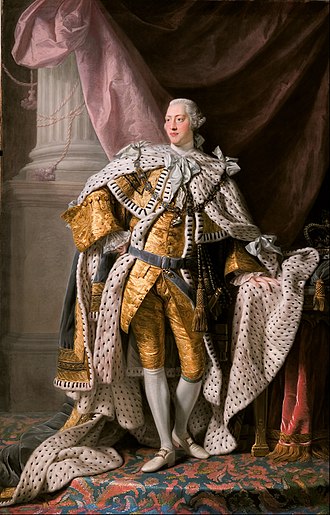
George III reigned for almost sixty years, through the loss of the American colonies and the long wars with revolutionary and Napoleonic France. He was born in London on 4 June 1738, the eldest son of Frederick, Prince of Wales, and Princess Augusta of Saxe-Gotha. He arrived two months early, was thought unlikely to survive and was baptised the same day. Educated by private tutors, he studied science in a systematic way, as no British monarch before him had done, and the interest later extended to an astronomical observatory of his own. When his father died in 1751 he became heir to his grandfather George II, and he succeeded him on 25 October 1760, aged twenty-two.
Unlike the two Georges before him, he was born in Britain and grew up speaking English, and he never once went to Hanover. In his first speech to Parliament he declared that he gloried “in the name of Britain”. On 8 September 1761 he married Princess Charlotte of Mecklenburg-Strelitz on the evening she arrived in London, and they were crowned together in Westminster Abbey a fortnight later. Unlike his father, his grandfather and his own sons, he never took a mistress. The couple had fifteen children, and in 1762 he bought Buckingham House, later enlarged into Buckingham Palace, as a family home.
The early years of the reign were politically unstable. The Seven Years’ War ended in 1763 with Britain the dominant European power in North America and India, but the cost of defending the colonies led to new taxes, beginning with the Stamp Act of 1765, and to the colonists’ protest against taxation without representation. More recent historians have tended to absolve George of personal responsibility for those policies. Once fighting began at Lexington and Concord in 1775, however, he refused to accept American independence and kept Lord North in office through a war that went badly after the British surrender at Saratoga and the entry of France in 1778. When word of Cornwallis’s surrender at Yorktown reached London late in 1781, North lost his hold on Parliament, and he resigned in 1782. George went as far as drafting a message of abdication, though he never sent it. Britain recognised American independence in the treaties of 1782 and 1783. In 1785 he told John Adams, the new American minister in London, that he had been “the last to consent to the separation” but would be the first to welcome the friendship of the United States as an independent power.
In 1783, after using his influence to defeat the Fox–North coalition’s India Bill in the House of Lords, he dismissed the coalition and appointed William Pitt the Younger prime minister. Pitt won a firm mandate at the next election, and the King grew popular, admired for his piety and his faithful marriage. In 1788 he suffered his first major attack of mental illness, sometimes talking for hours on end, and his doctors restrained him by force. Parliament was preparing a Regency Bill in 1789 when he recovered. The cause of his illness is still debated. A study in 1966 proposed the blood disorder porphyria, but recent scholarship favours a psychiatric illness, most probably bipolar disorder.
War with revolutionary France began in 1793. The Acts of Union joined Great Britain and Ireland as the United Kingdom from 1 January 1801, and George took the chance to drop the ancient claim to the title King of France. He refused, however, to accept Pitt’s plan for Catholic emancipation, believing it would break his coronation oath, and Pitt left office in 1801. When Napoleon threatened invasion in 1803, the King reviewed 27,000 volunteers in Hyde Park before enormous crowds and wrote to a friend that he would put himself at the head of his troops if the French landed. In 1807 Parliament passed the act that abolished the British transatlantic slave trade. He founded the Royal Academy of Arts in 1768, his interest in agriculture earned him the nickname “Farmer George”, and his library of some 65,000 books later went to the British Museum.
A final relapse came in late 1810, which he attributed to grief over the death of his youngest daughter, Amelia. Under the Regency Act of 1811 his eldest son governed as Prince Regent. George spent his last decade secluded at Windsor Castle, blind, increasingly deaf and unaware of events, including the death of Queen Charlotte in 1818. He died there on 29 January 1820, aged 81, having lived and reigned longer than any British monarch before him, and was buried in St George’s Chapel, Windsor. His son succeeded him as George IV.
Place in the family
- King George III was a grandfather of Queen Victoria.
- King George III was the second of 9 children of Frederick Prince of Wales and Augusta of Saxe-Gotha recorded in this archive.
- The archive records 74 of his descendants, across 9 generations.
Images
- George as Prince of Wales, pastel by Jean-Étienne Liotard, 1754 (Jean-Étienne Liotard, public domain)
- The marriage of George III and Charlotte of Mecklenburg-Strelitz, oil sketch by Joshua Reynolds, 1761 (Joshua Reynolds, public domain)
- Gold guinea of George III, 1789 (Coinman62, public domain)
- The elderly king in an engraving by Henry Meyer, 1817 (Henry Hoppner Meyer, public domain)


One of 35 people of House of Hanover (from 1700) in this archive. Called from Germany by the Act of Settlement; the Georges, then Victoria.
Line of descent: Owen Tudor → Edmund Tudor → King Henry VII → Margaret Tudor → King James V of Scotland → Mary Queen of Scots → King James I → Elizabeth Stuart → Sophia of Hanover → King George I → King George II → Frederick Prince of Wales → King George III.
Parents
- Frederick Prince of Wales (1707 – 1751)
- Augusta of Saxe-Gotha (1719 – 1772)
Siblings
- Augusta of Great Britain (1737 – 1813)
- Edward Duke of York (1739 – 1767)
- Elizabeth of Great Britain (1741 – 1759)
- William Henry Duke of Gloucester (1743 – 1805)
- Henry Duke of Cumberland (1745 – 1790)
- Louisa of Great Britain (1749 – 1768)
- Frederick of Great Britain (1750 – 1765)
- Caroline Matilda of Great Britain (1751 – 1775)
Partners
- Married Charlotte of Mecklenburg-Strelitz (1744 – 1818) in 1761 — 15 children together
Children
- King George IV (1762 – 1830)
- Frederick Duke of York (1763 – 1827)
- King William IV (1765 – 1837)
- Charlotte, Princess Royal (1766 – 1828)
- Edward Duke of Kent (1767 – 1820)
- Augusta Sophia of the United Kingdom (1768 – 1840)
- Elizabeth of the United Kingdom (1770 – 1840)
- Ernest Augustus King of Hanover (1771 – 1851)
- Augustus Frederick Duke of Sussex (1773 – 1843)
- Adolphus Duke of Cambridge (1774 – 1850)
- Mary Duchess of Gloucester (1776 – 1857)
- Sophia of the United Kingdom (1777 – 1848)
- Octavius of the United Kingdom (1779 – 1783)
- Alfred of the United Kingdom (1780 – 1782)
- Amelia of the United Kingdom (1783 – 1810)
Life
- 1738 — Born
- 1760 — George III becomes king on the death of his grandfather, George II.
- 1761 — Married Charlotte of Mecklenburg-Strelitz
- 1788 — George suffers his first attack of porphyria.
- 1810 — Final illness of George III leads to his son becoming Regent in 1811.
- 1820 — Died
- 1820 — Death of King George Ill, aged 81 years
Sources
- George III · Wikipedia
- George III (r. 1760–1820) · The Royal Family (royal.uk)
- George III · Westminster Abbey